
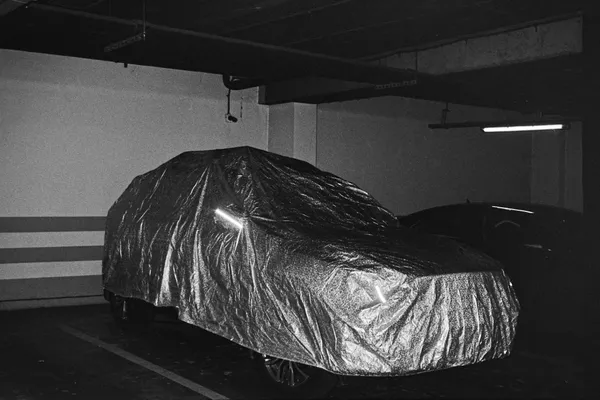
A car under a silver cover takes up the same amount of street as it did before. The wheels remain where the wheels belong, and the roof keeps its familiar height. Yet the object has become difficult to identify at a glance. Its most useful clues have disappeared beneath a loose surface. I find myself examining a vehicle I might otherwise have walked past, interested in the part of it that was supposed to keep attention away.
The cover is practical enough. It wraps around a recognizable volume and gathers where the shape becomes complicated. Along the roof it can appear almost smooth. Near a mirror or the corner of a bumper, the fabric bunches into folds that have very little to do with the design underneath. Those interruptions are what make the covered car worth a second look. A carefully drawn body has acquired an improvised outer layer.
The shape underneath
Silver makes the transformation more pronounced. Light slides across the material in uneven bands, turning a shallow crease into a bright edge. A darker fold can look deeper than it is. From one angle, the surface resembles thin metal. A small movement of the fabric gives it away. I enjoy that brief uncertainty between something rigid and something that would collapse into a heap if the car were driven out from beneath it.
The comparison to sculpture begins with the outline. Remove the glass and the recognizable arrangement of headlights, and you are left with a volume to walk around. The shape has a front, though it may take a moment to locate it. Parts of the cover hang closer to the ground than others. The viewer becomes unusually conscious of where the object meets the pavement, because that is where the wrapping stops making it seem weightless.
I’m aware that I’m supplying a gallery to an ordinary parking space. The curb has become a boundary around an object that never asked for one. This is part of the pleasure, and part of the joke. The car will eventually return to being a car. Someone will lift the hem of the cover, gather up the loose material, and put it away. For now, the usual information has been withheld.
A badge can settle your impression of a vehicle before you have considered its proportions. The cover postpones that recognition. You have time to notice the height of the hood in relation to the roof, or the length of the rear section. I catch myself trying to identify what is underneath anyway. Then a large fold runs across the place where I expected to find a clue, and I go back to looking at the cloth.
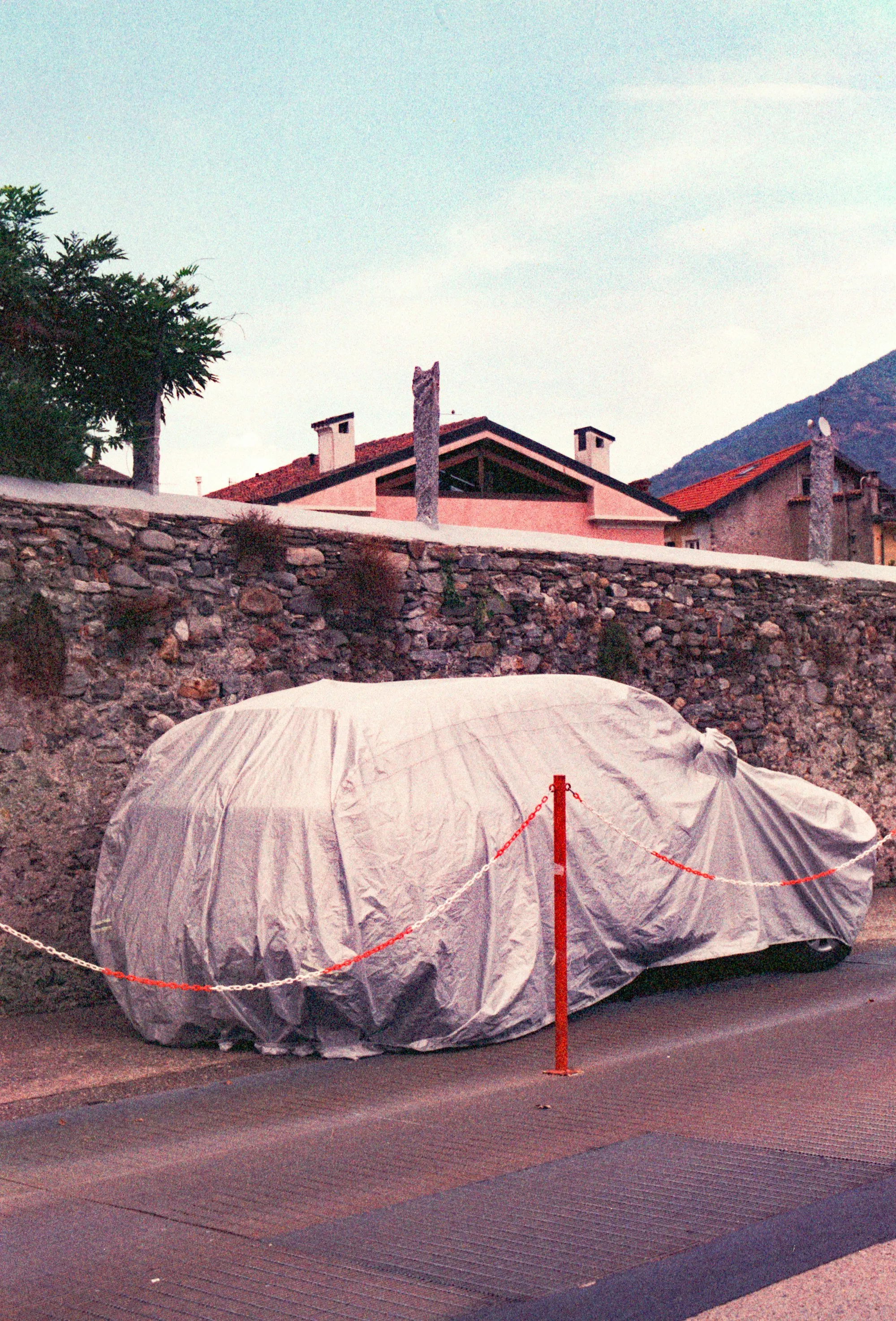
Under cover
The familiar outline stays. Its usual explanation has been folded out of sight. For a while, shape gets to make the first impression.
The folds have their own arrangement. Some follow the car closely enough to describe it. Others cross a door or a window at an angle that belongs entirely to the cover. Two sets of lines occupy the same object, and they don’t quite agree. A taut section gives way to a slack one. That uneven fit keeps the surface from becoming too polished. There is always somewhere for the eye to get caught.
Photographing such a thing involves deciding how much of the street to include. Close in, the material can become almost abstract, a set of pale ridges against dark pockets. Stand farther away and the car returns as a thing that has been parked. I prefer the distance where both readings remain available. Enough pavement helps. So does a little ordinary space around the object, where nothing especially interesting has been arranged.
At pavement level
That space changes the photograph’s tone. A covered car against a seamless background would look like an object being prepared for inspection. On a street, it has to share the frame with whatever happens to be there. The surroundings interrupt its temporary elegance. I like that interruption because it gives the picture a place to belong. The photograph can remain interested in form without pretending the car has escaped its daily use.
There is a similar effect when fabric is thrown over a chair while a room is being painted. The backrest becomes a ridge. An arm becomes a blunt projection. You still know what the thing does, but the surface stops helping you recognize it. I sometimes leave the fabric in place for a moment longer than necessary, simply to see how much of the furniture I had been identifying by its upholstery.
Objects give away a great deal through their finishing details. A seam can tell you where a hand is expected to go. A shiny patch suggests where something has been touched. The car cover replaces many of these signals with ones produced by its own construction. Its hem becomes a new edge. A gathered corner becomes a new focal point. Looking at it feels like seeing a familiar sentence with several words temporarily obscured.
Another vehicle pulls up beside the covered car and changes the available view. I make one last picture from pavement level. Most of the roof has disappeared from this angle. The silver material gathers close to the ground, where a few loose inches of fabric form the clearest edge in the frame.