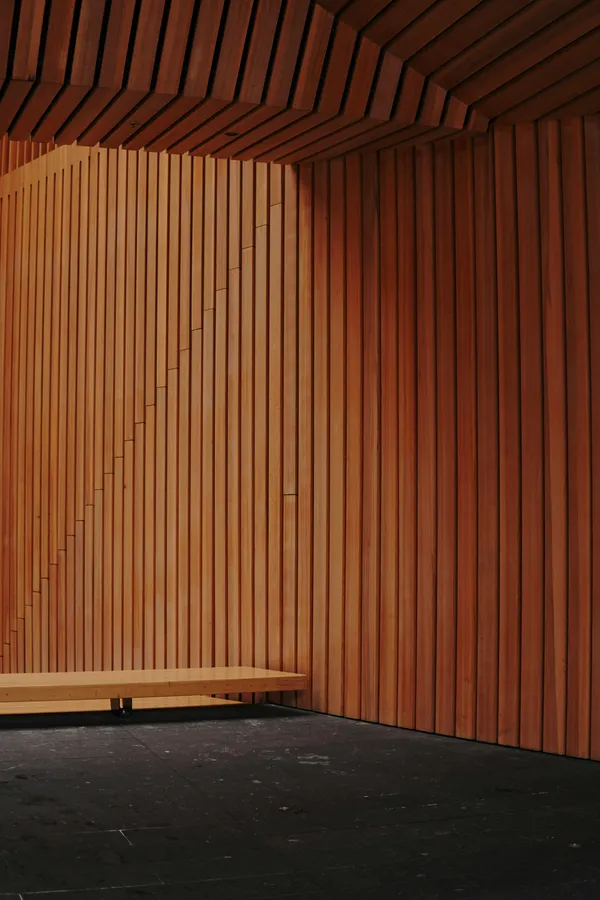
A small bench stands against warm wood paneling. The wall gives the interior a continuous tone, while the seat makes a low horizontal line within it. I notice how much of the room remains around this one piece of furniture. Someone could sit there for a few minutes and then carry on, leaving the arrangement much as it was. The possibility is easier to see in a photograph than it is when I’m moving through a place with something else to do. It makes me look again at where an ordinary route allows a person to stop.
I tend to notice public seating when I need it. A heavy bag makes a bench visible from the other end of a square. So does a friend who hasn’t arrived, or a sandwich bought on the way to somewhere else. Until then, it is easy to read a street as a route and overlook the places along its edges where movement can stop.
A bench changes that reading. It gives the person sitting down a position in the scene. From there, the corner that looked ordinary while walking past has a view, with a near edge and a far one. The line of a roof becomes apparent. A delivery van parks, leaves, and reveals a doorway. You can watch these changes without having to manufacture a reason to be there.
The position of the seat matters as much as its shape. Facing another bench produces a different kind of place from facing a road. Turn the seat toward a wall and the space feels closed; put it beside a planted edge and people can look out while keeping something behind them. Even a slight angle changes whether two strangers seem to be sitting together.
Comfort involves equally specific judgments. I want to put both feet on the ground. I want a surface that doesn’t gather water in the middle, and somewhere to rest my back if I stay longer than expected. A handsome object photographed from across a plaza may be a disappointing place to sit. The body finds the unresolved parts of a design very quickly. So does a bag that has to balance on a narrow strip of seat, or a walking stick with nowhere convenient to lean. The space immediately around the bench is part of its usefulness.
The position of the seat matters as much as its shape. Facing another bench produces a different kind of place from facing a road. Turn the seat toward a wall and the space feels closed; put it beside a planted edge and people can look out while keeping something behind them. Even a slight angle changes whether two strangers seem to be sitting together.
On a street I walk often, one bench catches the sun while the next remains under a tree. People choose between them with the seriousness of choosing a table in a restaurant. Someone spreads out a newspaper. Someone else sits at the very end, leaving room for a person who might come along later. The available shade becomes part of an informal arrangement that changes through the day.
There is an odd generosity in a seat you don’t have to buy anything to use. You can wait badly, read only half a page, or sit without looking occupied. In a busy area, this can feel like a rare piece of unfinished time. The design has to allow for a person who isn’t making a particularly photogenic use of it.
That is why I like photographs of empty benches. Their emptiness leaves the practical questions open. Which seat would I choose? Where would I put my bag? Would I turn toward the light or away from it? A row of furniture becomes a set of possible afternoons.
When I leave the bench on my usual street, I sometimes look back from the corner. Its proportions change at that distance. The backrest becomes a short dark line, the legs almost vanish, and the person who has taken my place is the clearest part of the design.