I had walked past the corner building for years before noticing the narrow window above the sign. It was open at the top, with a pale curtain caught behind the frame. From the opposite sidewalk, the sign had always taken up most of my attention. Looking above it changed the proportions of the building. What I had thought of as a shop occupied a small part of a much taller surface.
The first photograph was mostly a record of the discovery. I stood where I could see the window and pointed the camera toward it. At home, the picture contained a generous amount of blank wall and the edge of a neighboring building that seemed to lean into the frame. The curtain was difficult to distinguish. I went back the following week and spent more time deciding where to stand before lifting the camera.
On that return, I left the sign in the lower corner. It gave the window a position in a building I could recognize, even though neither element filled much of the image. A passing bus briefly hid the lower part of the facade. The composition became simpler and less useful to me. When the bus moved on, I could see why I wanted to keep a little of the street.
Choose a position on the ground
Looking up begins with the space available at foot level. There may be a doorway behind me, a bicycle against the wall, or people using the route I am hoping to stand in. I find a position where I can stop without becoming an obstacle and look from there. That limitation has produced some of the photographs I prefer. It requires me to work with the distance I have instead of imagining a viewpoint in the middle of the road.
From close to a wall, the upper floors can appear to narrow dramatically. I sometimes like the way this makes the surface seem to climb. Elsewhere, it changes the building so much that the picture becomes mostly about the angle of the camera. Moving farther away lets me include less of that effect. I try both positions when I can, then compare how much of the image depends on the tilt.
A small change sideways can be more consequential than a large change in distance. A drainpipe disappears behind the corner of a wall. A gap opens between two rooflines, showing a strip of sky that looked closed from the previous position. I pay particular attention to those gaps. They can separate buildings that have begun to read as one shape, or make a composition feel divided in a way I hadn’t intended.
I use the edges of the frame to check these decisions. If a dark roof touches the top border, I try giving it a little more space before taking another picture. Sometimes it needs that room. In another image, the contact with the edge helps explain how closely the buildings are packed. I can’t settle the question by following one rule about where a roof ought to end. I have to look at the rest of the photograph.
Looking up begins with the space available at foot level. There may be a doorway behind me, a bicycle against the wall, or people using the route I am hoping to stand in. I find a position where I can stop without becoming an obstacle and look from there. That limitation has produced some of the photographs I prefer.
Let the sky take a shape
A bright sky can make the facade beneath it seem relatively quiet. I notice this when an uneven roofline becomes the clearest edge in the picture and the windows below lose much of their individual character. The photograph starts to describe a boundary rather than a building. I may keep it that way, but I make another frame with less sky to see whether the surface itself has something I have passed over.
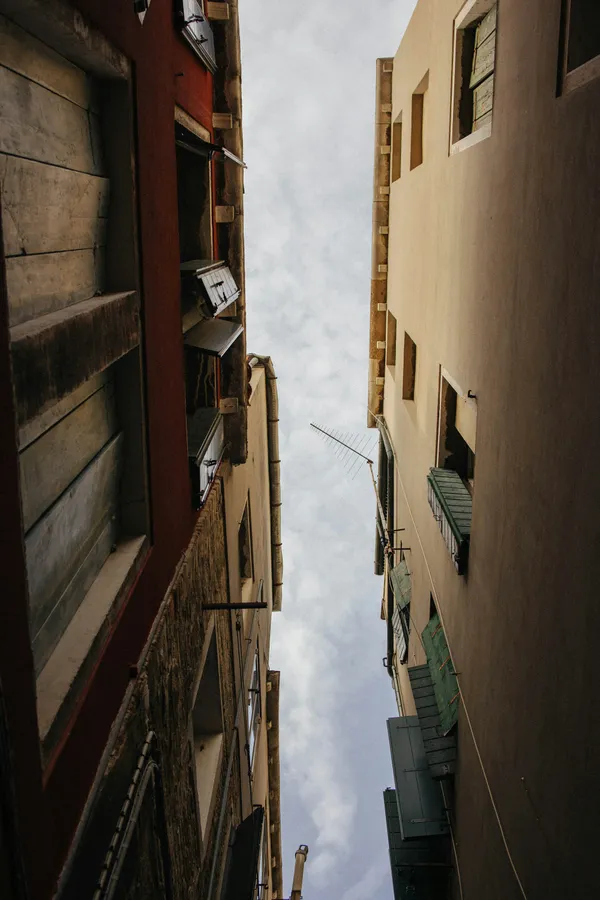
There is a small passage on one of my usual routes where the buildings leave a crooked opening overhead. Photograph it from the entrance and the opening appears broad. Walk farther in and it becomes a thin shape between the walls. I have taken several versions without finding a clear favorite. Each position changes which wall seems to belong to the foreground, even when very little of the material is visible.
The light inside a passage can also make the upper stories seem detached from the street. A bright strip near a cornice may sit above several floors in shade. The eye jumps to it before working down through the windows. I follow that movement with the camera lowered first. When the route through the scene interests me, I look for a frame that lets it happen without requiring an explanation beside the image.
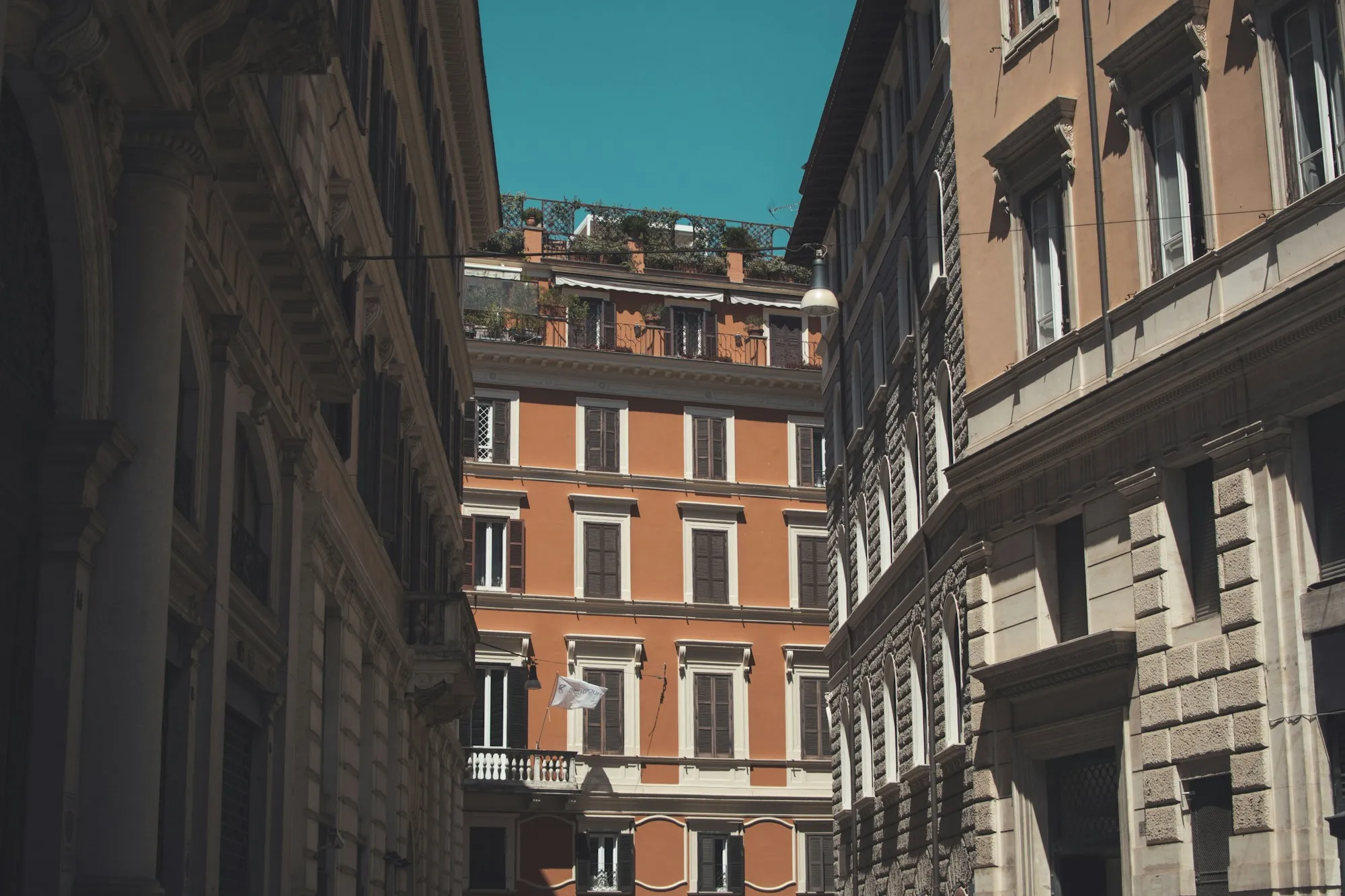
Photos by Unsplash
The photographs gathered here come from separate viewpoints and places. Put together, they make it easier to compare the spaces around an architectural line. A slice of sky can have much the same visual weight as a pale section of wall, although they belong to very different distances. I look at the sequence for those shifts. The images needn’t pretend to describe one continuous walk to be useful beside each other.
Bring the street back into the frame
After spending a while looking upward, I have to remember the lower part of the scene. It is easy to make a building appear isolated by excluding the shopfront or the person waiting beneath it. That can be appropriate for a study of its surfaces. On a walk, I often want something of its daily use to remain. A window above a working entrance means something different in the picture from the same window floating over an unseen ground floor.
I usually make the wider photograph as well as the close one. The wider version can be untidy, with a sign interrupting a clean vertical or a parked vehicle hiding the base of a column. When I return to the pictures later, that interruption sometimes becomes a point of entry. I can imagine standing there. The closely framed image asks me to look at the building from a position that the photograph has carefully removed.
A picture can suggest scale without a person in the frame. A handle beside a doorway may be enough to suggest the height of the wall above it. So can the regular spacing of a railing, depending on how much of it remains visible. I like finding those ordinary points of reference because they let a photograph feel inhabited even when nobody happens to cross the frame. They are easily lost when I crop too quickly.
The small window above the sign was shut on my most recent visit. Without the curtain, its upper edge looked heavier, and a reflection divided the glass into areas I hadn’t noticed before. I took a photograph from the position I had used last time. Then I moved farther down the sidewalk, until a line from the neighboring roof crossed behind it. The familiar corner gave me another reason to stop.