
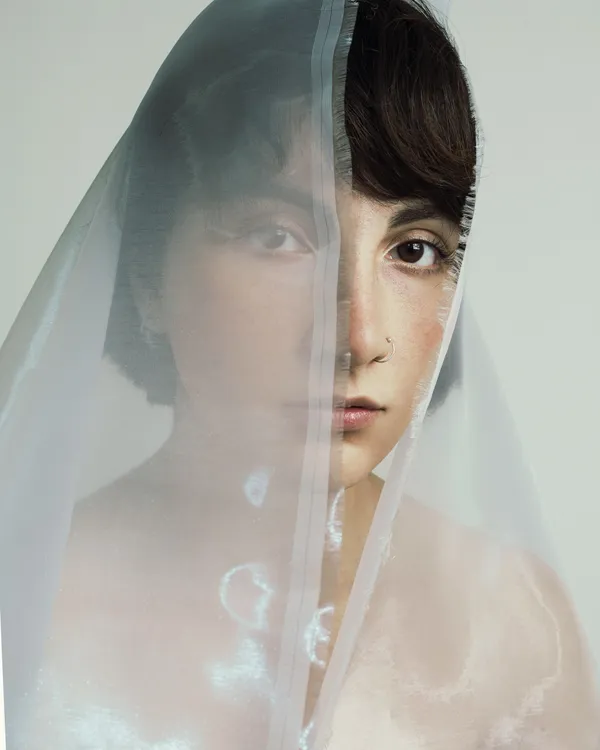
Across part of the face, a white fabric interrupts the view. The transition is gradual. One side retains a clear outline, while the other becomes less distinct beneath the material. Before the cloth reads as an object with its own thickness and folds, it can resemble a change in the photograph itself, as though different parts of the image have been brought into focus at different distances.
The gray background gives us little help in measuring those distances. It offers a cool, even field around the person’s short dark hair. Against that restraint, the white fabric has more than one job. Its brightness separates it from the background, and its partial transparency allows the covered features to remain present. The face continues across the frame, with different amounts of information available on either side.
It is tempting to think of the visible and veiled areas as two separate halves. Looking longer makes that division seem less exact. There are intermediate areas where a contour remains readable but its texture becomes difficult to distinguish. A fold in the cloth can provide a sharper line than the feature behind it. The eye follows whichever edge it can find, moving between the person and the material in front of them.
Fabric makes these changes through an ordinary physical relation. Light reaches the face and passes through the material unevenly as its thickness and angle vary. Where the cloth folds back on itself, it can appear denser. A more open section permits a clearer view. The photograph lets those differences remain visible together. We don’t have to imagine the fabric being removed to understand that it occupies a separate layer.
I find the small nose ring useful as a point of reference. It is a detail I can name with some confidence, alongside the haircut. Neither tells me how the person spends their days. A conspicuous accessory can encourage a quick reading of someone’s style, but that reading uses associations brought by the viewer. Here, the ring also has a simpler visual role: it gives the face another distinct shape to set against the diffuse fabric.
Returning to the transition between the clear and veiled areas, I try to locate the point where the face begins to lose its definition. There is no single crisp division to settle on. The change gathers across a small area, with the material becoming easier to follow as the feature behind it softens.
The cloth’s pale surface keeps drawing attention away from those smaller details. Looking at a translucent material involves repeated adjustments. You can attend to the surface itself, following its fold, or try to see what lies behind it. The two ways of looking occupy the same part of the picture. Once I begin following the fabric, I notice how readily I had treated it as something to look through and then forget.
This makes the portrait feel different from an image with a blurred background. The interference sits between the viewer and the subject, in the place where we expect a clear view. It has weight and an edge that belong to the scene. Even so, the material never completely closes the view. Features remain available in softened form, and their continuity helps us understand the parts that are harder to see.
How much a face can explain
A portrait leaves a great deal unresolved even when the face is entirely clear. We might describe an expression, then discover that another viewer uses a different word for it. The fabric makes that uncertainty more apparent. It would be easy to call the image guarded, although the photograph gives no reliable account of the person’s willingness to be seen. A visible barrier is a feature of the composition. It cannot speak on the subject’s behalf.
Similar care is useful with words such as vulnerable or distant. They may describe our experience of the picture, especially when one eye or part of the mouth is difficult to read. Attached directly to the person, those words begin to sound like information about their character. I prefer to keep the description close to what the image provides: a face partly veiled by white fabric, with a clear area beside a softer one.
That description leaves room for the person to have a life outside the image. The short hair and the nose ring remain specific, but a few visible choices do not amount to a biography. We have no account of the conversation before the portrait or the moment after it. The gray field gives almost nothing away about the room. The photograph holds this particular arrangement long enough for us to inspect it, while the rest stays elsewhere.
There is still a relation between the viewer and the person shown. It doesn’t require us to assign a mood or invent a meeting. We spend time with the features we can see, and notice where our attention hesitates. The cloth slows the easy recognition of a face, especially along the soft boundary where the material crosses it. A familiar act of looking becomes more deliberate because the image makes us aware of its surface.
Moving farther from the picture changes the balance again. The fabric becomes a broad pale shape, and its folds carry less detail. The dark hair holds a firmer outline against the background. Closer up, the differences within the white area become easier to follow. Both views belong to the same portrait. They give us different routes across it, with the material taking a larger or smaller share of our attention.
I don’t need a final explanation for why the fabric is there. Its presence is already doing something precise: allowing part of the face to remain legible while altering the route by which we see the rest. A caption could provide the circumstances of the photograph, if they were known. That information would add context, though it would leave the uneven passage of light through the cloth available for another look.
Returning to the transition between the clear and veiled areas, I try to locate the point where the face begins to lose its definition. There is no single crisp division to settle on. The change gathers across a small area, with the material becoming easier to follow as the feature behind it softens. My eye moves along the fold for a moment, then finds its way back to the uncovered part of the face.