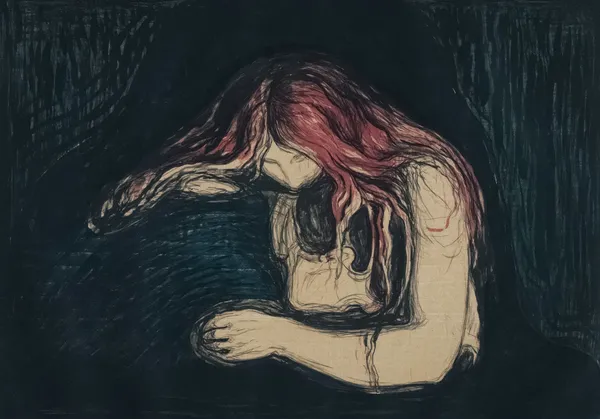
From the far side of a room, a painted face can seem remarkably settled. You see where the head rests, the direction of the gaze, a dark area of hair against the surface below it. The body arranges itself into a recognizable pose before you have noticed much about the paint.
Then you move closer. An edge that looked firm from a distance turns out to be soft. A bright patch near the cheek is larger than expected. The face still makes sense, although it now takes a little effort to keep seeing it as a face. Your attention moves between the person in the picture and the marks that allow the person to appear.
I enjoy the point where those two readings begin to interfere with each other. It usually arrives before I am close enough to examine a small detail. The whole image is still in view, but I can no longer take its apparent completeness for granted. I find myself looking at the side of a hand, then having to step back to recover the pose.
A dark portrait makes this adjustment especially noticeable. The background can initially seem like a single area of black. Stay with it and differences become visible. One part is warmer, another has a faint reflection, and a shape you thought belonged to the body may belong to the space behind it. The picture has not changed. You have given your eyes another job.
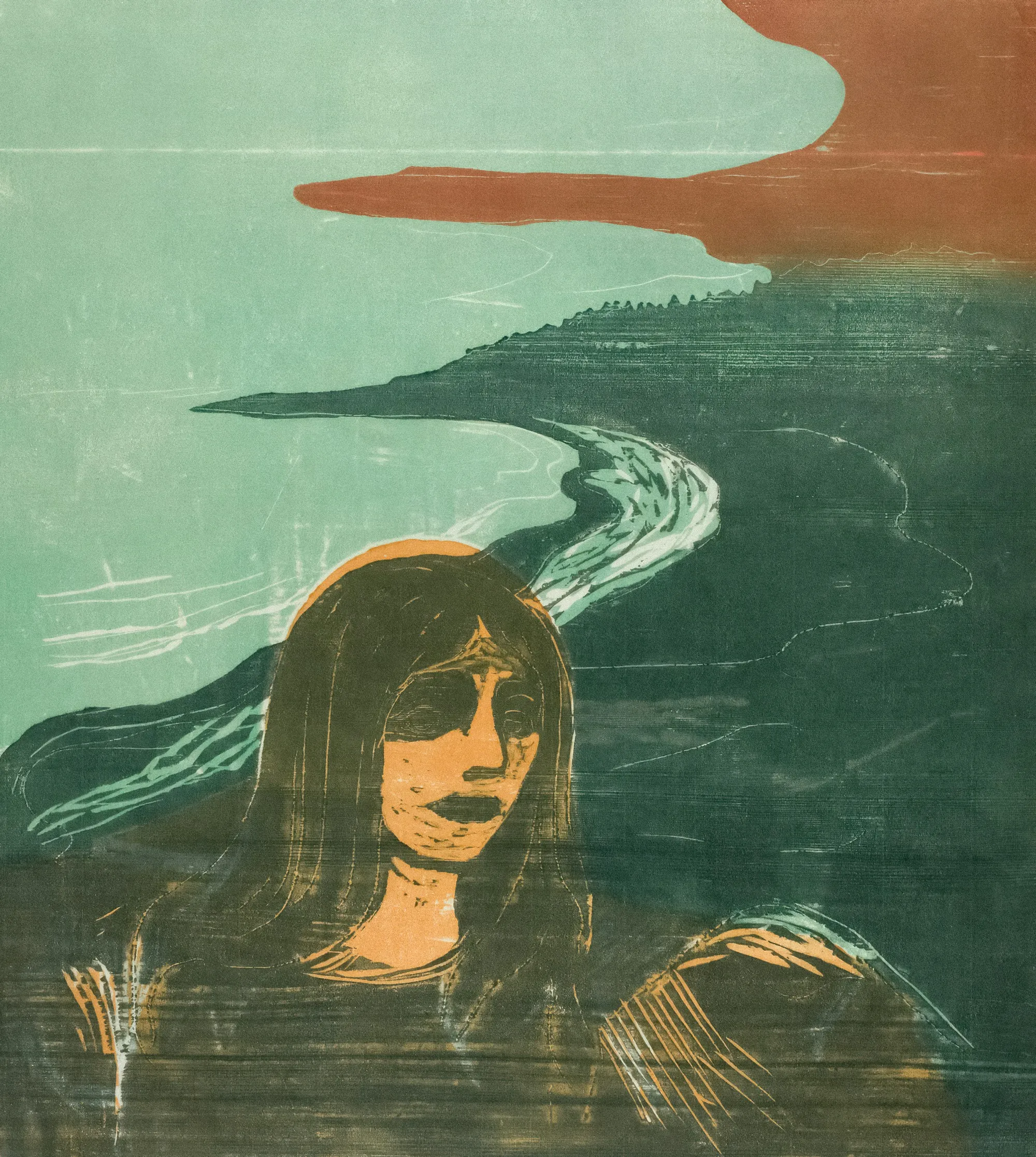
A little distance
From close up, I start following an edge or a patch of color and lose track of the whole face. A little distance lets the marks settle into an expression again. Moving between those views keeps both readings available: the person in the picture and the surface that brings them into view.
This is also why the same portrait can feel different in a book. Its size has been decided for you. A face that might occupy only a small part of a large canvas now fills most of a page. You can move the book closer, but the relation between your body and the image has already changed. The edges of the paper remain insistently near.
On a screen, I make the adjustment almost without thinking. I enlarge an image until a detail becomes clear, then scroll to find the part that has disappeared. This is useful for examining a brushstroke or a strand of hair. It also produces a kind of closeness in which the composition is temporarily missing. I can spend several minutes with the eye of a portrait while forgetting the posture of the head.
A studio photograph offers another way of paying attention to this movement. The light on a face is easy to read as a description of its shape. Look at the edge of the illuminated area and the decisions become more apparent. Where does the light stop? How much detail remains in the shadow? Does the background separate from the hair or let the two run together?
There is no need to reconstruct the equipment to ask these questions. I rarely know what was placed outside the frame, and a convincing guess would still be a guess. The visible result gives me enough to consider. A small change in tone can move a face forward. A nearly lost shoulder can make the head appear to float, until a little more of the picture comes into view.
I once spent longer looking at a reproduction of a painting than at the work itself. At the gallery I had been aware of the room, other visitors, and the distance I was expected to keep. At home I had a book open on the table and could return to it over the course of an afternoon. I am reluctant to rank those experiences. They asked for different kinds of looking, and each revealed something the other had made difficult to see.
These days I try to change position before deciding that I have finished with a picture. I cross the room or lower the book. Sometimes the change adds very little. Sometimes a large dark shape resolves into the back of a chair, and an expression that seemed melancholy becomes ambiguous again. I go back to my first position to see whether I can still find the face I thought I understood.