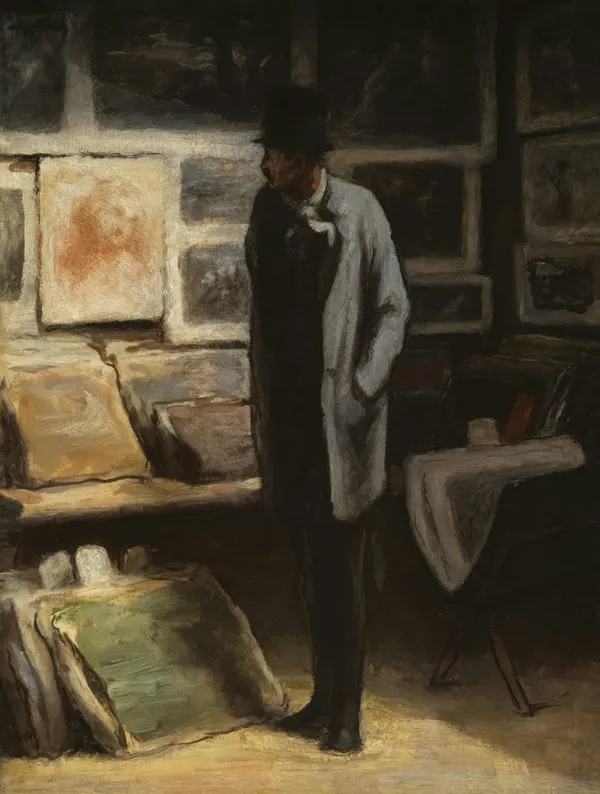
The room is crowded with pictures before I begin to distinguish what any one of them shows. Frames and loose images gather toward the left, some leaning against one another near the foreground. A gray-coated figure stands to the right, facing the gathered work. I follow his glance across the room before returning to the figure and the space around him.
The work placed low down is particularly interesting. An image leaning near the floor asks for a different position from a picture set at eye level. I imagine a viewer stepping closer or bending slightly to see it. In the painting, the surrounding frames make even that simple approach seem something to negotiate. Looking involves finding a place in a room that is already occupied by the things being considered.
A frame separates one picture from its neighbors, although it cannot make the neighbors disappear. Their edges remain beside it. A dark image can make a pale area in another work easier to find, while a repeated shape can draw the eye out of the picture it started with. I notice these movements most when I have gone into a room intending to look closely at a single work.
The figure gives this room a point of concentration without resolving where my own attention should rest. I can look at the gray coat as a shape within the larger painting, or consider the person’s position in relation to the pictures. Each reading changes the room. In one, the figure helps hold the composition together. In the other, the work has gathered around someone who may be choosing where to begin.
Looking in company
The figure’s attention gives the gathered work a reason to occupy the room. Some pictures appear easier to approach than the rest. I imagine beginning with one of those, then wanting to see an image that is partly hidden. A visit could move between these two impulses for quite some time. The painting leaves the encounter open while making its surroundings quite specific.
I think of the times I have looked through a group of images while another person waited nearby. Their presence changed the pace. I might spend longer with a picture that I wanted to discuss, or move past one before I had finished with it because I couldn’t yet explain what held me there. Later, alone, I would sometimes return to the image I had found most difficult to say anything about.
Looking together can make details available that I had passed over. Someone points to the edge of a smaller picture and I begin to notice it in the larger arrangement. It can also make me unusually aware of the time I’m taking. I try to leave room for the stretches when nothing useful needs to be said. A person standing quietly beside the work may be attending to a different part of it.
A frame separates a picture from its neighbors, although the neighboring edges remain in view. A dark image can make a pale area in another work easier to find, while a repeated shape can draw the eye out of the picture it started with. I notice these movements when I arrive intending to look at just one work.
The loose description of the room helps keep those possibilities alive. Some edges are easier to follow than others. Cream-colored areas emerge from the dark olive and brown, then stop short of giving me every detail I might ask for. I can recognize the presence of several pictures without being able to read their subjects. Their position in the room becomes more definite than the images inside them.
A room around the frame
The neighboring pictures remain in view, even when we arrive intending to look at only one.
That seems appropriate to a scene about looking. The painting makes the surroundings of attention visible: where the work is placed and how someone stands near it. The individual images retain enough uncertainty for me to imagine continuing to examine them. I find myself looking at the same patch repeatedly, trying to separate a pale picture from the frame beside it without forcing the marks to become more precise than they are.
In an orderly display, I might expect a clear route from one work to the next. Here, the low, leaning pictures interrupt that expectation. One can partly hide another, and an edge can turn away from the direction I want to see it from. I can picture the small adjustments that would make a work easier to inspect. The painting holds the arrangement before those adjustments have been made.
The painting is also an image among whatever I have looked at before it. Seen after a bright landscape, its dark room takes me a moment to enter. After another interior, I notice the difference between their open and crowded areas. I don’t need to place the works physically beside each other for a comparison to begin. The earlier picture is still present in how I approach the next one.
Choosing a picture from such a group would change the group as well. An opening would appear where the work had been, and an edge previously obscured might become available. This is something I notice when moving images around at home. A picture that seemed settled beside one neighbor can look unexpectedly isolated when that neighbor goes elsewhere. I often have to look at the remaining arrangement before deciding what to put back.
The room in the painting remains intact. I can imagine a picture being lifted into the light, but I cannot see what that change would reveal. Instead, I return to the figure’s position and follow the direction of attention toward the gathered work. The loose shapes near the floor still ask for a closer look. Their edges lead into one another, giving me several ways to enter a group whose separate images remain partly out of reach.