The first thing I see is the reflection in the glasses. Two small areas of brightness interrupt a face that is otherwise difficult to separate from the room. They hold my attention while the rest of the picture begins to emerge.
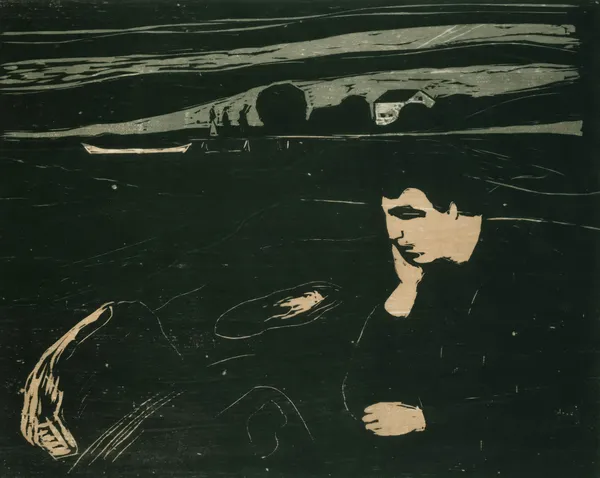
At first, the darker passages seem to belong to one another. A coat, the edge of a seat, and the space behind the figure have similar weight. I can identify enough to understand that someone is there. The more interesting details arrive slowly, after I have stopped asking the picture to declare itself all at once.
I like this kind of image partly because I am impatient with it. I want the face to be legible and the direction of the gaze to be clear. Reflections in lenses interfere with both. They turn a useful object, something intended to help a person see, into a small obstruction for the person looking at the portrait.
In a photograph, the same reflection might send someone back to adjust a light. In a painting, it can become the place where the eye settles. Either way, the bright patch has a shape of its own. It might be a window, a lamp, or only a few marks that suggest a source beyond the frame. I can enjoy its position without deciding what produced it.
There is some pleasure in having to wait for an image to become comfortable to look at. I cannot hurry that adjustment by concentrating harder. I can only stay with what is visible and let another detail arrive. The experience is small enough that it is easy to overlook when discussing a picture, yet it often decides which pictures I remember.
This happens to me in actual rooms too. Enter a dim theater before the performance and the people already seated are initially a collection of partial views. A pale collar appears first. A face turns toward the aisle and becomes visible for a moment. The room gradually acquires depth, although very little has happened to explain it.
There is some pleasure in having to wait for an image to become comfortable to look at. I cannot hurry that adjustment by concentrating harder. I can only stay with what is visible and let another detail arrive. The experience is small enough that it is easy to overlook when discussing a picture, yet it often decides which pictures I remember.
With a dark image reproduced on a screen, I have an additional temptation: turn up the brightness until everything is available. Sometimes that helps me see a detail I want to examine. Sometimes it makes the scene feel oddly thin. The dark areas that held the composition together become a set of separate objects, each asking for the same amount of attention.
I usually turn the brightness back down. The glasses become apparent again, and a few edges disappear. I can still find the figure because I now know where to look. There is a second chair, or what I take to be one, at the side of the frame. I spend a while trying to decide where its back ends.