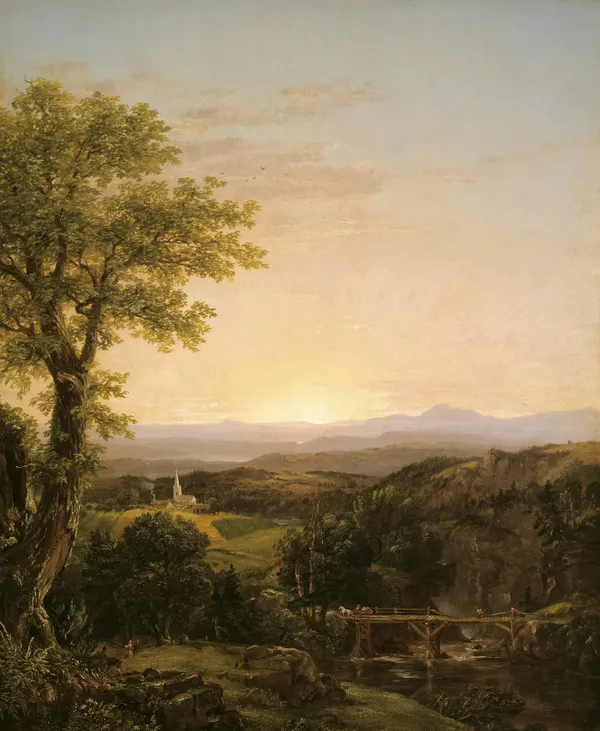
The small bridge is where I enter the landscape. It sits low in the picture, toward the right, crossing a dark stretch of water. I can imagine the short movement from one bank to the other before I have worked out much about the country beyond it. From that near position, the bright distance becomes a place to look toward. The painting gives me a route into its space without showing the whole journey.
On the left, a large leafy tree holds much of the foreground together. Its weight changes how I read the open area beside it. The brighter part of the landscape might seem to spread freely across the image if the tree were absent. Here, I encounter that opening from beside something substantial. The branches and foliage remain close enough to make the distant hills feel farther away.
The bridge gives the eye a short crossing before the larger landscape opens beyond it. I can follow that movement without deciding exactly where the route would lead. The dark water remains close, while the brighter ground draws my attention farther into the picture. Both distances stay available as I look from the near bank toward the hills.
I return to the dark area beneath the crossing because it is less easily resolved than the light beyond it. The water belongs to the scene, though I cannot inspect its course in the same way I can follow the bridge. Some of its shape remains held among darker forms. Looking there slows the passage into the view. I notice the foreground as a place with depth, rather than an edge to get past.
Where the distance opens
A small building elsewhere in the landscape provides another scale. I recognize enough of it to understand that the space could be inhabited, but it never takes over the picture. My attention moves between the building and the larger tree, comparing the different amounts of the scene they occupy. The bridge supplies a third position at which a person might enter this view, even though I don’t need to place someone visibly on it.
The warm light in the distance has an effect on these comparisons. It makes a relatively open area feel available after the crowded foreground. I look toward the hills, then find that I want the darker tree back in view. The image becomes less particular when I concentrate on the bright area alone. Each passage changes how much attention I give to the other.
There is a movement across the picture as well as into it. The tree draws me to the left; the crossing and the opening beyond it bring me toward the right. I don’t follow this in one dependable order. Sometimes I begin with the brightest area and come back down to the water. At another distance from the image, the tree becomes the first shape I can identify, and the rest assembles around it.
The bridge gives the eye a short crossing before the larger landscape opens beyond it. I can follow that movement without deciding exactly where the route would lead. The dark water remains close, while the brighter ground draws my attention farther into the picture. Both distances stay available as I look from the near bank toward the hills.
That change is part of what keeps me looking. A landscape can be familiar in its ingredients and still make their arrangement difficult to exhaust. Here I can name the bridge and recognize a tree without settling how much of the picture belongs to each. A broad dark area may hold the eye longer than a smaller, more explicit detail. I spend time along the meeting between the foliage and the lighter space beside it.
I resist trying to turn the painting into a map. The glimpse beyond the bridge suggests that the country continues, but the picture offers only this particular opening. There may be routes I cannot see, and distances I cannot measure. I can stay with the visible relation between the near crossing and the bright hills. It is enough to imagine making one small movement within that larger space.
When I look again at the lower right, the bridge is easy to find. I follow its span over the water, then pause before carrying on toward the light. The dark area underneath remains in the corner of my view. From this position, the small crossing feels less like a detail added to the landscape than a place from which its distances can begin to make sense.